Sustainable ecosystem evolution
Click to expand the Alt-text to the diagram.
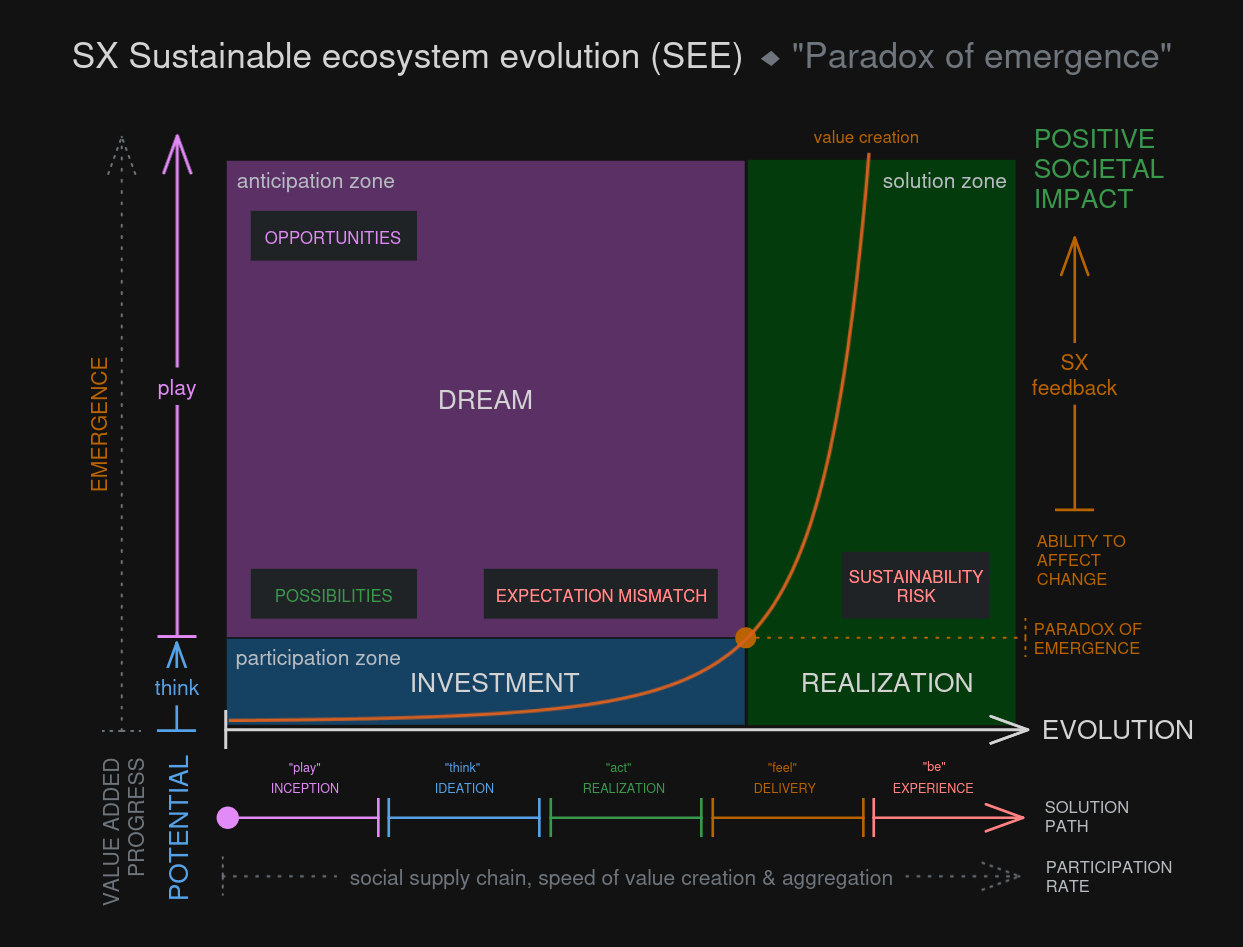
The diagram shows an exponential ‘value creation’ graph, with on the X-access the progress of evolution along the solution path. Below the axis the various lifecycle stages of the fediverse service delivery lifecycle are listed: Inception, Ideation, Realization, Delivery, Experience. Rate of value creation & aggregation of the social supply line depends on participation rate.
On the Y-axis is the Potential of the solution design, where value-add of investment in the solution depends on how emergent design leads to desired outcomes. It is not easily perceived as it exists mostly still in emergent space.
Diagram has 3 quadrants. On the bottom left the participation zone is where prolonged Investment is asked, while only little value can be demonstrated in the field. The biggest part above the participation / investment zone is the anticipation zone, where we dream and find possibilities and related opportunities that may have great potential. Expectation mismatch is a risk as the emergent value is stil invisble to most people.
The paradox is solved at an inflection point along the evolution axis of the solution, called appropriately ‘the paradox of emergence’ point, when actual value is demonstrated by positive societal impact that grows via SX feedback loops. This is the solution zone, the full right side of the diagram, where value creation can grow exponentially and dreams turn to their realization. Now there are sustainability risks to healthy evolution to monitor well.
This topic relates to Grassroots open standards for fediverse evolution and Sustainable ecosystem evolution which are applied research topics of Social experience design (SX).
SX follows a sustainability-first approach dedicated to bridge the gap between hard technology space of the Social web developer ecosystem, which represents a pure technosphere, and Social web where the people are, fedizens in the sociosphere. The simple credo and vision of Social coding commons, a grassroots movement, aims to ..
Reimagine “Social” and Realize our dreams of a
peopleverse that’s inclusive to all people.
Sustainability risk: Chisms in grassroots standardization process?
A wicked problem in chaotic commons is that everyone does their own things, goes their own direction, and the power of the commons remains dormant, and directionless, unfocused. The commons then represents an inert gas that can make no fist against the forces it rallies against and wants to protect itself from. The following quotes from @silverpill makes me wonder how they relate to the stance and position of the FEP within the larger ecosystem. For any open standard, thus also for a Grassroots standard the people, esp. potential adopters and implementers need clarity on that.
I am not here to question personal opinions and principled stances, which I respect and honor. I am a long-time anti-BigTech humane technology advocate myself, and consider fediverse a humane tech field lab of sorts. I want to keep it “for the people, by the people” which was and is the principled stance I’ve always and still follow today.
The FEP is effectively run as a typical FOSS project, and on a basis of “do-ocracy” - " An organization in which power and responsibility are held by those who do the most work." which is the same basis that sees me take the initiative to follow-up on matters of long-term FEP sustainability right now.
- How does the FEP Process consider its relation to W3C and bottom up standardization?
- To what extent do stance and positioning of the FEP align with ecosystem participants?
- Which risks to position of the FEP as a standards body do exist now, and in the future?
- How do we deal with them if serious matters arise, and how can we mitigate these risks?
- How can the FEP Process guarantee the shared responsible ownership that exists today?
- Is the notion of a 3-stage bottom up standardization process still acknowledged by FEP today?
Sustainability risk: Can FEP Process induce shared (technology) vision?
In my call-for-reflection on grassroots ActivityPub developer ecosystem I provided my thoughts on the extent to which fediverse is able to represent The Future of the Social networking.
Any healthy ecosystem needs to foster and have a general consensus on a shared (technology) vision. I addressed the lack thereof in 2022 in my notes on major challenges that ail the fediverse, which are all social in nature..
- Should the FEP play an active role in fostering shared vision to encourage cohesion?
- Is it enough to be a neutral process open to anyone, or reject non-aligned FEP submissions?
- Is FEP Process sufficiently prepared for controversial submissions, able to avoid “drama”?
With this topic I hope to open this general discussion, which should imho become part of a continual monitoring process of well-known (SX) sustainability criteria that the FEP Process evolves.
 Join FEP Process do-ocracy today
Help make our

peopleverse happen!
Vacancies: Commons custodians of the fediverse
Apply now and help brighten our collective future.

– “Urgent platitutes” by Arnold Schrijver, social coder.