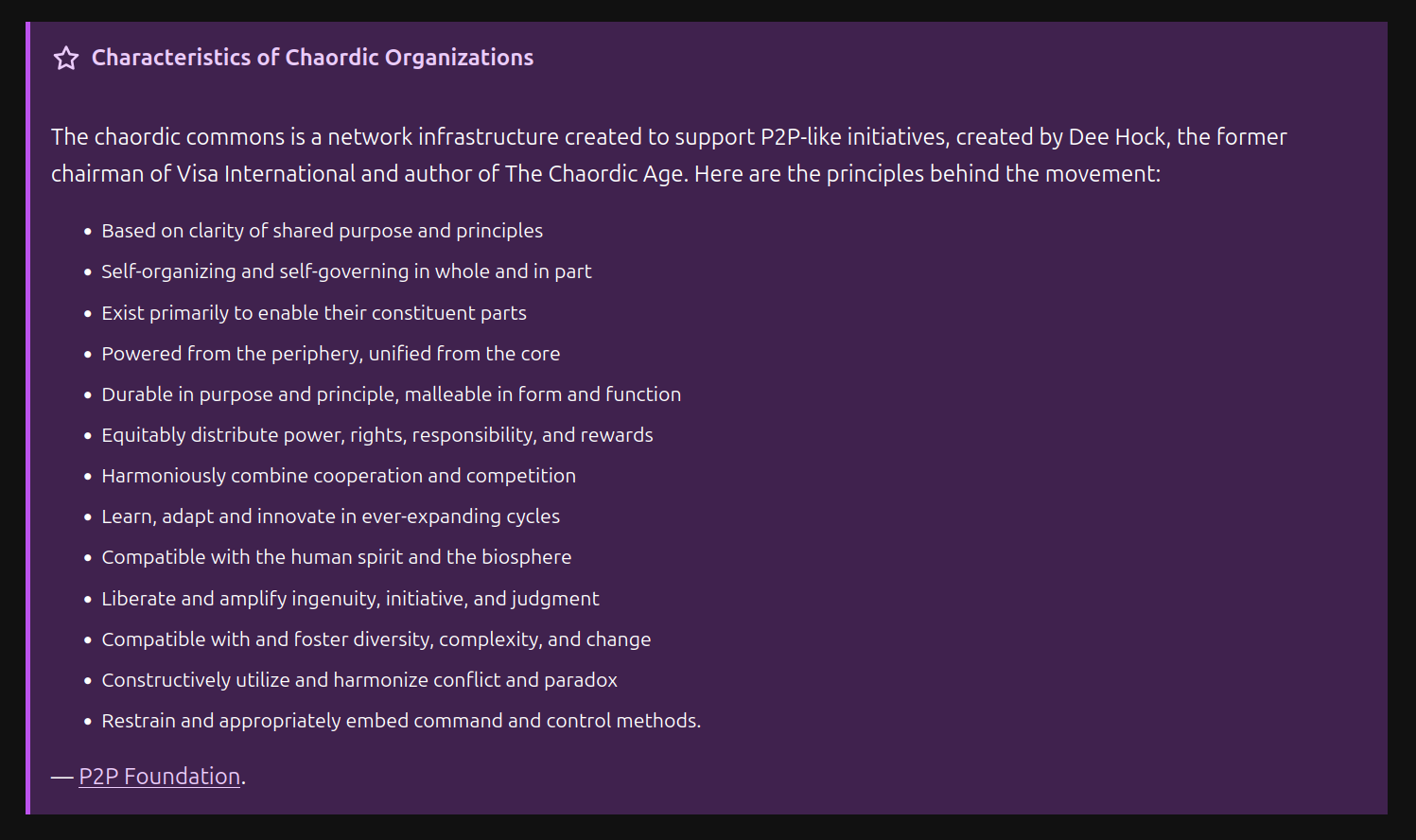
Grassroots open standards for fediverse evolution

Alt-text to the diagram. Click to expand the text.

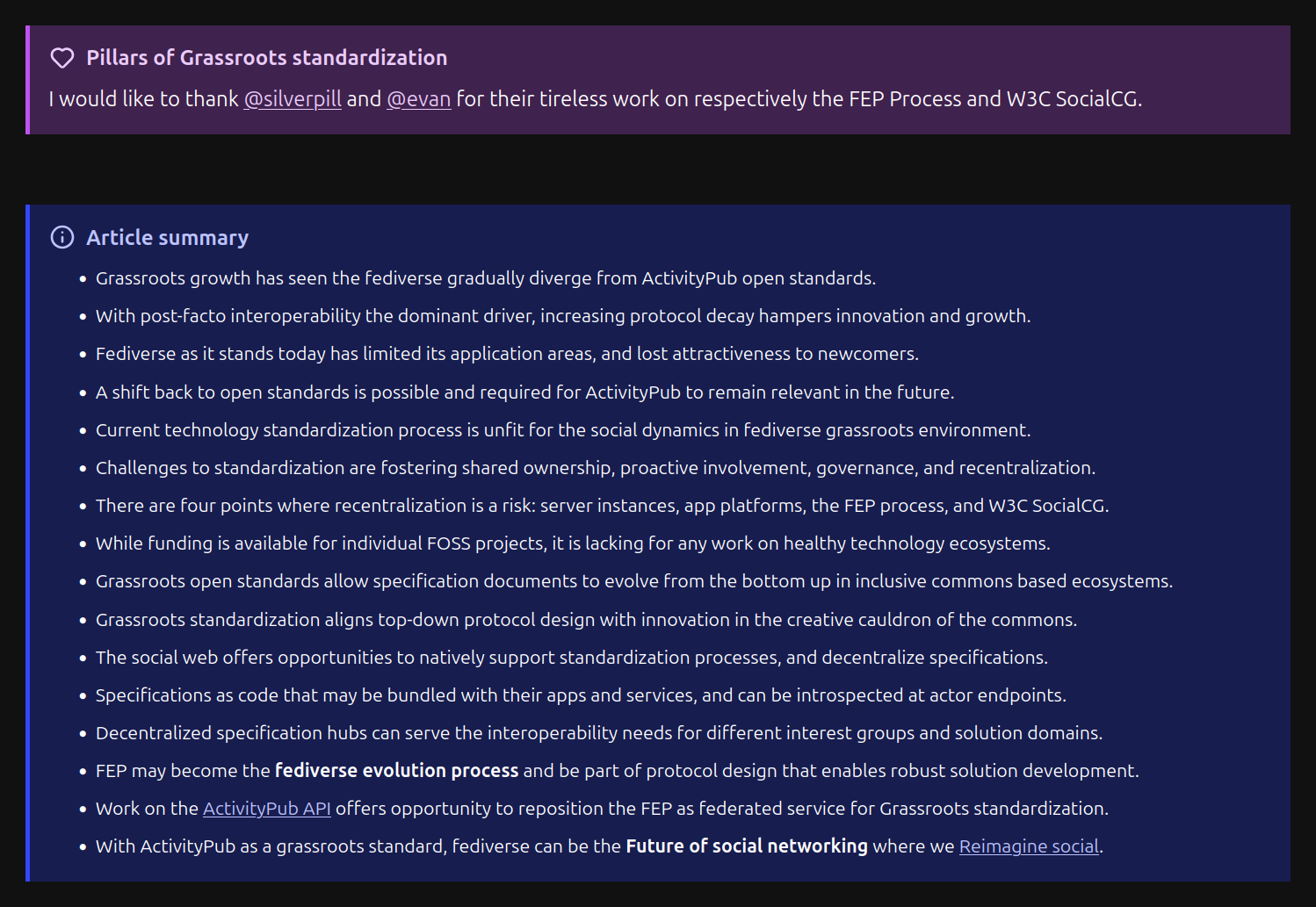
  • Grassroots growth has seen the fediverse gradually diverge from ActivityPub open standards.
  • With post-facto interoperability the dominant driver, increasing protocol decay hampers innovation and growth.
  • Fediverse as it stands today has limited its application areas, and lost attractiveness to newcomers.
  • A shift back to open standards is possible and required for ActivityPub to remain relevant in the future.
  • Current technology standardization process is unfit for the social dynamics in fediverse grassroots environment.
  • Challenges to standardization are fostering shared ownership, proactive involvement, governance, and recentralization.
  • There are four points where recentralization is a risk: server instances, app platforms, the FEP process, and W3C SocialCG.
  • While funding is available for individual FOSS projects, it is lacking for any work on healthy technology ecosystems.
  • Grassroots open standards allow specification documents to evolve from the bottom up in inclusive commons based ecosystems.
  • Grassroots standardization aligns top-down protocol design with innovation in the creative cauldron of the commons.
  • The social web offers opportunities to natively support standardization processes, and decentralize specifications.
  • Specifications as code that may be bundled with their apps and services, and can be introspected at actor endpoints.
  • Decentralized specification hubs can serve the interoperability needs for different interest groups and solution domains.
  • FEP may become the fediverse evolution process and be part of protocol design that enables robust solution development.
  • Work on the ActivityPub API offers opportunity to reposition the FEP as federated service for Grassroots standardization.
  • With ActivityPub as a grassroots standard, fediverse can be the Future of social networking where we Reimagine social.

Thanks to @silverpill and @eprodrom, the pillars of grassroots standardization and ecosystem cohesion. :two_hearts:

What triggered me to write the blog post was in relation to another discussion I started, and where I added this:

For the “promise and power” of going “back to standards” consider this:

@aschrijver

A bug in @Discourse #ActivityPub plugin? cc @angusmcleod

Image from the subject 3 times included, and with the #AltText being the filename, not the alt-text I gave in the #forum post.

Just for the record, I do not agree with the premises of that article.

Fediverse doesn't gradually diverge from the ActivityPub spec and software development doesn't look like you describe.

Overall, it looks like an attempt to discredit FEP process by painting it as ineffective and unsustainable, in favor of... I am not entirely sure, GitHub repo and a non-profit?

Not at all. You misread and misinterpreted me then. Or you just skimmed the article, which I can imagine as it is a whopping one hour read. But the blame of misunderstanding is likely on my side, as I have a complex material to convey. The FEP is fabulous! It is the ‘as-best-we-can’ approach to follow in a chaotic commons. However, there are serious sustainability risks, which I address in the article. Where FEP is “just a bandaid” is measured against the most optimal process, which is the evolution goal of a SX solution, should that development methodology be practiced. The most optimal solution requires sustainable chaordic commons and continous evolution. The whole blog post is written from perspective of Social experience design, which I have been elaborating for the past couple of years.

What is further in the article is merely brainstorm. The article is ‘appeal-for-reflection’ and hopes to inspire new ways of thinking and fresh ideas. There are plenty variations for impl and process improvement to distill from that, but the most radical approaches see FEP become protocol-native.

As for explaining it all and properly, for crystal clear understanding.. There’s a paradox there, which I just realized yesterday and am trying to formulate clearly. Related toot: The Paradox of Emergence.

I don’t know if you noticed, but I called you a pillar of the fediverse and true hero, that is all genuine, and I am grately thankful to you. :two_hearts: If fediverse had more commons janitors like you, it would tackle the grassroots evolution issue much faster. Most FOSS devs don’t realize I think how many of the boring chores are kept away from them, so they are free to experience the joy of coding. Things should be more fairly delegated, a grassroots evolution point of improvement.

As a frequent participant of FEP-related discussions, you know that we always tried to keep it simple and minimal. It is designed to be sustainable and can work without heroes and funding.

That’s why it is still operating. I literally spent more time writing this comment than I spend reviewing PRs in FEP repository in an entire week.

A couple of quotes from you blog post:

I concluded above that the current FEP process is unsustainable. If the current volunteer(s) burn out and leave, and no others step to the plate, then the FEP will likely lose relevance quickly and eventually be abandoned altogether. If the fediverse sees corporate capture, then the FEP will be replaced with something deemed more professional in the eyes of business people.

The “professional” version of it already exists, it’s called W3C Social Web Working Group. Did it replace FEP?

… a purpose-built portal website that is being further improved right now. But it is all custom development and organization in a different techstack and toolstack than what is commonly used by ActivityPub developers in their federation projects. Furthermore the website is already being forked at random disconnected places, not upstreamed, and risks seeing forks turn into hard forks that lead to further fragmentation of the ecosystem.

What are you talking about? What techstack? Where are all those forks?

We use Python, one of the most popular programming languages, and mkdocs, the most popular static site generator in the Python ecosystem. Again, all of it was built with sustainability in mind.

The website and scripts are maintained by Helge, by the way. Stop trying to make it look like I am the single point of failure.

Your choice by not believing I am not criticising you. :winking_face_with_tongue: And if its brainstorm, or design, it takes time and requires slow text-typing comms. Or “Hammock driven development”, if you do it all by yourself on a lazy Sunday.

You are feeling attacked for no good reason. I am in no way critical of you, nor of the FEP. Once again I say, on the contrary so. In fact no one is to be blamed or criticised under SX for the things they do, unless of course they clearly go against norms and values, breaking CoC etc.

SX is emergent evolutionary design for solutions that have societal impact. A quite holistic design method with and on basis of emergent forces, in emergent grassroots ecosystem. When I talk about ‘sustainability’, it is scoped against the full width and breadth its circles of sustainability and during the lifetime of a solution’s entire FSDL, and at the level of the entire grassroots (technology) ecosystem.

I am working on SX as a concept developer who models the design language for SX, and while applying SX at the same time, as I go along. It is a very pragmatic method, in the way that works.

With the subject of elaboration and against the major fediverse challenges, all social in nature, I wrote down in the SX notetaking forum in 2022, I am calling for a brainstorm session on What is the power and potential of ActivityPub? And of the fediverse? What is the Future of Social Networking? What is the potential role of ActivityPub open standards in that? Can we reimagine social, and imagine a peopleverse? Can the fediverse support that? And are we moving in that direction, yes, or no, and at what pace? And what are the risks to holistic sustainability along the way? If there are major risks, how can we mitigate or eliminate them?

To further inspire people to be imaginative and think out of the box, a number of vids are referenced. Four, if I remember correctly, like “The Future of Social Networking” (the retitling is makes the talk still apply), and “Stop Drawing Dead Fish” (about how we things, because we are used do them that way, not because it is the best way), both by Bret Victor.

FEP team made all the best and pragmatic choices, is improving all the time, Python is a perfect choice, and I am sure the static site generator stack is perfect too. I like it myself, though I use another techdocs documentation tool. You do your “stinking best” as I phrased it. All is good. You are a hero. And you are modest to say “Hey, its nothing, just costs me hardly any time, and I don’t need money either”. All great, fabulous even. Splendid. And I love and applaud it.

But is FEP holistically sustainable against what this brainstorm aims to explore? If you don’t want that brainstorm, that is fine. Ideation works best with people who are open to it. And also I am asking people to reflect on their own, first of all. If you say “yes, sustainable” that’s fine too. I think it isn’t. another opinion. But likely also from a different (social) context and perspective than you have. These too are SX concepts. Some reasons and risks are mentioned in my article. There are more.

As for that techstack / toolstack. If FEP is implemented as fedi app, there may be Mitra and Bonfire instances you can host a ‘FEP Facilitation service’ on, or however you name it. If it is protocol native, which is now not clearly scoped what that exactly means, then every AP implementor following the latest specs releases will have to add the support.

I’ve seen various forks, friendly I think, to have stuff local, or prep a PR, did not tracked their location. I’ve seen a proposal to make a separate independent FEP portal that takes the Open Data from Codeberg FEP to build the site. Didn’t go through I think. Perhaps fine, or there are things to consider. Might brainstorm on it. In my article this corresponds to having different fediverse server instances hosting Specification hubs.

A misunderstanding of meaning, likely. Suppose hypothetically a Big Tech, say Microsoft, goes all-in on AP with the full brunt of Microsoft Research and 20,000 employees. And triggered by this IT market developer, in quick succession well over a 1,000 businesses and enterprises followed. Hurray :tada: fedi will certainly “crossed the chasm” now. What will happen? They find W3C specs lacking. This is well-known, even by the creators, so no surprise. Undoubtedly @eprodrom gets many helping hands in the SocialCG quite quickly I assume, able to innovate and in a larger team that requires more attention to responsible governance, a sustainability criteria in the case of a standards process.

As for the FEP Process the following will likely happen [.. you take the brainstorm, or not, up to you].

I’ve explained enough to know you should not feel offended, and neither defensive. Lastly, a brainstorming nudge regarding the FEP sustainability topic to perhaps inspire you with:

:round_pushpin: Are there frictions between the upstream W3C and downstream FEP, and vice versa? If so, what are these, and how can they be taken away? How can the standards process be further streamlined in this bottom-up standardization process we are emerging in our grassroots (and not quite yet “commons based” under SX terms) ecosystem?

Btw, curious question. What did you fill in at the Poll in the blog announcement post, if anything?
I am not interested in playing these games.

And it looks like you do not intend to edit your blog post. Alright, let’s see how it will age.

You are not even prepared to listen then, it comes across to me. It is the sign of our times. Patience, listening to each other. Having trust in the other’s good intent. These are rare things these days. If you lack trust, I can’t convince you this is well-intended and the call for reflection about fedi’s future is lost on you. Everyone is free to do what they want in our commons, as long as they take proper account of what other people do. If you like to code, code away, no problem. This is part of SX too. Go where you find affinity with others. But remember that cohesion is a quality too in social networks, especially in the role of open standards custodian.

A sustainability risk of the FEP, if you want to know one, is your impatient communication and how it leads easily to frictions that shouldn’t exist.

If you read well the article, you would see that instead of criticism it muses and hints at a very exciting future where the FEP Process plays a key role to the facilitation of Grassroots open standards. One that is not only useful for the custodianship of ActivityPub, but potentially for any open standard.

I am preparing a new blog post, related to the one discussed in this thread, which deals with sustainable evolution of grassroots ecosystems. The toot below is a pre-announcement with the diagram that shows “The Paradox of Emergence” that rears its head in many ways, and makes it difficult for us to organize ourselves into a grassroots chaordic commons instead of remaining a chaotic one.

@silverpill this article introduces the SEE model, which stands for Sustainable ecosystem evolution, and makes central the role in the commons of the Commons janitor, people like you, @eprodrom and me, who strive to foster and care for the ecosystem to nurture cohesion between individual participants who often narrowly focus on their own projects and plans. This is key to increasing overall sustainability levels. For the FEP there are many exciting improvements and extensions to be ideated on, and many of those have been discussed in the past already. The more people chime in, the sooner they might materialize, and ideas realized instead of on the back log for the long haul.

Not knowing the extent of you reading my blog post, but it seems you still misinterpret things. Since concrete FEP sustainability matters are tangential to this call for reflection and ideation, in true style of the SocialHub do-ocracy nature I formulated a call for people to volunteer our efforts.

See: 🫂 Commons custodians. Help increase FEP Sustainability and progress

If you parsed my article other than skimming, you would’ve read that for me, and many others before me, fediverse hasn’t aged well in comparison to the power and promise ActivityPub held, and many expert devs and protocol designers before me have left the field looking for greener social web pastures. For me, a mere generalist and commons janitor, it may end the same. My blog post doubles as the dreaded ‘FOSS emergence call’ that comes to most people who spend too much time in unsustainable social impact movements. I hope to find sustenance in what I find most important wrt fedi: adding social social to coding coding and help bring coding coders closer to fedi fedizens, to better addres their needs. If that doesn’t work, I may walk out into the :sun: and call it a day.

Perhaps @silverpill this analogy I just tooted, about atoms, petri dishes, and a paradox that exists, may convince you that I’m not playing silly games of politics and criticism. How could I, a simple atom giving my two cents, have any reason, any reason whatsoever, to be critical of other atoms like me that try to bring together others and shape healthy organisms, living free. I am merely trying at different cross-particle ecosystem levels, crossing areas of expertise, try to adopt a broader perspective. It is not easy. But easily misunderstood, I am sorry. :folded_hands:

I can’t know what your intentions are. I am just saying that this narrative you’re constructing helps neither me nor the FEP process.

To reiterate:

  • I am not the sole active maintainer of the FEP repository.
  • We try to make it long-term sustainable to the best of our abilities.

Also, I would appreciate if you stop tagging me in your posts. I don’t have anything left to say on this topic.

I will honor and respect that, Silverpill, of course. Though you could know what my intentions are, as I wrote at length about them: innovation beyond a point where we are now, and exciting FEP work where e.g. you for instance might combine Mitra more closely to FEP-adjacent work, and have a kind of win-win. That’s all. :revolving_hearts:

Maybe it would help to name the other active maintainers along with the number of commits they’ve made to the repo in 2026?

There is a FACILITATORS.md that keeps track of that (not with commits). I just PR’ed to it for an update. [Update] Ah wait, you mean an automated list. In the PR I suggested a Dormant section for FEP team members who are not currently active, but still on call should active members be unreachable when there’s need to reach them. It would be great to have a Contributor section in the README.md of the kind which you see regularly in larger community projects on Github. That might be a reusable Forgejo thingy, FOSS project in the Forgejo Contrib org.

I’m aware of that file. A name in a file doesn’t mean “active maintainer of the FEP repository” to me. Using commit count as a metric, I only see one active maintainer.

1 Like

Yes, cross-posted with my Update, thanks, great suggestion.

See FACILITATORS.md. It currently lists 4 facilitators, and all of them are available if the need arises. 3 are active in Fediverse and on this forum. Helge and I are actively involved in governance decisions (FEP-a4ed requires at least two approvals for such changes).

My commits constitute the majority of recent commits, but that doesn’t mean that I am the only active maintainer. As I just explained, there are two regular participants, and all governance decisions are made in accordance with FEP-a4ed.

It should also be said that all automatic commits made by our CI system are attributed to me, and I am the author of more than 20 FEPs, which I regularly update.


I find this sudden increase of level of scrutiny quite puzzling. Am I accused of any wrongdoing? If so, please be clear about it.

It is quite unfortunate that in addition to tolerating constant harassment on this forum I am now expected to provide detailed git activity reports.

For my part I couldn’t have done more to profusely try to say to you: No, not at all. In my article I took FEP and its role in the overall standardization across the fediverse, now and in future, and also addressed W3C and general dynamics by which fediverse ecosystem matures. Main topic was the concept of Grassroots open standards, which may be carried on the Social Web, potentially solving issues standardization bodies typically have around their role as necessary points of centralization to provide ‘source of truth’ across the ecosystem. The increased level is due to yourself, I suppose, with the suspicion and distrust, which I too don’t deserve given all I contributed in the past.

Sorry, the previous question was mostly rhetorical rather than asking for activity data. The data is publicly available to anyone. In 2026, you are the only maintainer with commits. For me, a “regular” (occasional) participant in governance decisions is not the same as “active maintainer of the FEP repository”. In the last several years, a very significant majority of commits have been yours.

There’s obviously nothing wrong with this (and thanks for your work! :folded_hands: ), but it doesn’t support the breadth of participation you’ve been repeatedly claiming. Given that, it seems reasonable to me that someone might have sustainability concerns.